Alright, let’s cut to the chase—if you’re running heavy equipment operations (think mining, construction, or bulk material handling) and you’re the one in charge of scraper feeder chain tension, you probably don’t think twice until something breaks. But here’s the thing: too tight isn’t “just a little extra tension” — it’s a silent killer that’ll cost you way more than the 10 minutes you’d spend adjusting it right. As a scraper feeder chain supplier who’s worked with 100+ fleet managers over the past 8 years, I’ve seen way too many avoidable breakdowns that all trace back to one dumb, avoidable mistake: cranking that tension nut as tight as it’ll go “just to be safe.” Let’s break down exactly what happens when your scraper feeder chain is too tight, why it matters way more than you think, and what you should do instead. Scraper Feeder Chain

First, let’s level-set for anyone who might not be deep in the weeds: a scraper feeder chain is that loop of heavy-duty steel links with bolted scrapers (the big plates that push coal, ore, or gravel along the feeder trough) that runs the length of your feeder. Tension is the amount of pull on the chain—enough to stop slacking (which can cause scrapers to drag in the trough or jump sprockets) but not so much that it’s fighting against every moving part it touches. When you crank it too tight, you’re putting stress on literally every component in the system, not just the chain itself.
Let’s start with the chain itself, because that’s the part you might think is indestructible, right? Wrong. Scraper feeder chains are built for high load, but they’re not designed for constant over-tension. The steel links are precision-forged to flex just a tiny amount under normal load to absorb impact from bulk material. If the chain’s stretched beyond that (because tension’s too high), the steel fatigues faster than you can say “outage.” I once had a mining client in Wyoming who swore they “didn’t have time” to adjust their chain—they ran it at max tension for 3 weeks straight. Half the links on the lower run snapped during a 2 a.m. shift, shutting down their ore processing for 12 hours. That cost them over $40k in lost production, plus the emergency chain replacement (which they’d have avoided if they’d just loosened the tension by 1/8 inch). Why does the chain fatigue? Over-tension turns each link into a rigid, stressed part—every cycle it runs, it’s bent tighter than it should be, leading to hidden micro-cracks that pop unexpectedly. It’s not just the links either; the pins that connect the links can shear off prematurely, or the rollers (if you’ve got a roller chain, which most modern feeders use) seize up because they can’t rotate freely under excessive force.
Next up: the sprockets. Those big, toothed wheels that the chain wraps around? They’re made of hardened steel too, but even hardened steel has a limit. When the chain’s too tight, it’s pulling on the sprocket teeth with way more force than they’re engineered for. I’ve seen sprocket teeth wear down 3x faster than normal because the over-tensioned chain is grinding against them constantly. Worse, the sprocket shafts—those solid metal rods that hold the sprockets in place—can bend. A bent shaft doesn’t just mess up the chain alignment; it throws the entire feeder system off, leading to even more chain slacking or uneven wear. Another big one: sprocket bearings. Every sprocket has a sealed bearing to let it spin smoothly. When the chain’s over-tight, the sprocket can’t rotate freely—so the bearing has to work against a constant sideways or radial load. That causes the grease in the bearing to break down way faster, leading to dry bearings, overheating, and catastrophic failure. I had a construction client in Texas last year who replaced two sprocket bearings in 6 months because they’d cranked the chain too tight to prevent slipping. Normal bearing life is 2–3 years for their feeder—they cut that down to 8 months, just because of over-tension.
Wait, what about the drive system? That’s the motor, gearbox, and coupling that’s pulling the chain. Most people don’t connect chain tension to the drive, but here’s the link: your motor and gearbox are rated for a specific amount of torque to move the chain and material. If the chain’s too tight, the drive has to output way more torque to move it—way more than it was designed for. Over time, that extra torque wears out the gearbox gears, strips coupling teeth, or even burns out the motor windings. I once had a grain handling facility in Iowa that their motor burned out because they kept their chain so tight that the drive was working 20% over its rated capacity 24/7. They didn’t realize it was the chain tension—they thought their motor was just “worn out.” Nope, it was the unnecessary stress from over-tension.
Now, let’s talk about the hidden costs that don’t show up on maintenance logs: wasted energy and increased material wear. When your chain’s too tight, more of the drive’s power goes into pulling the extra-tight chain instead of moving the scrapers and the bulk material. Studies (and yeah, I’ve run tests with our own chain kits) show that over-tightening a scraper feeder chain by just 15% increases energy consumption by 10–12%. For a feeder that runs 10 hours a day, that’s an extra $50–$100 a month in electricity costs—money that’s just getting poured down the drain because of a bad tension adjustment. And then there’s the scrapers themselves. Those bolted plates that push the material? When the chain’s too tight, it pulls them harder against the trough, so they wear out faster, and the trough lining itself takes more abrasion. I’ve seen scraper plates wear through in 6 months instead of 18, just because of over-tension.
But wait, don’t get me wrong—slack is bad too. I’m not telling you to let the chain hang loose like a piece of string. The sweet spot is enough tension to stop the chain from jumping sprockets or dragging excessively in the trough, but not a pound more. So how do you get it right? Here’s a quick, practical tip I give all my clients: use the “deflection test” when the feeder’s off (never adjust tension when it’s running!). Loosen the tension lock nuts, then adjust the take-up bolts (the ones that move the rear sprockets forward or backward) until you can push the middle of the upper chain run (between the two sprockets) 1–2 inches with your thumb and index finger. That’s it. Any tighter, and you’re adding unnecessary stress. Any looser, and you’re risking slacking. For our heavy-duty 10-inch pitch chains, that deflection number can go up to 2.5 inches, but never more—we print that right on the installation manual, but I still see clients skip that step.
I get it—when you’re in a rush, it’s easy to crank tension. “If a little is good, more is better,” right? But with machinery, that logic doesn’t apply. I’ve seen a $500 tension adjustment fix a problem that would’ve cost $10k in replacement parts and lost production. Last quarter, a mining client came to me after their chain snapped mid-shift, shutting down their operation for 14 hours. They’d tried to fix a small slack issue by cranking the tension too high. We replaced their broken chain, adjusted the tension to the right spec, and added a tension monitoring kit (super cheap, like $200) so they can check it without shutting down. Since then, they haven’t had a single chain failure. That’s the kind of win we love as a supplier—helping our customers avoid the dumb, expensive mistakes.
Now, let’s address the elephant in the room: what if you’re already dealing with over-tension issues? Don’t panic. First, shut down the feeder safely, adjust the tension down to the recommended deflection, and inspect all components for damage. If you’ve got a chain that’s already got fatigue cracks, don’t keep running it—replace it before it snaps. If bearings or sprockets are worn from over-tension, those are easy fixes too. But the best fix? Make tension checks a regular part of your maintenance schedule. Every 2 weeks, do the deflection test. After any major shutdown, adjust tension before you restart. Don’t wait until something breaks.
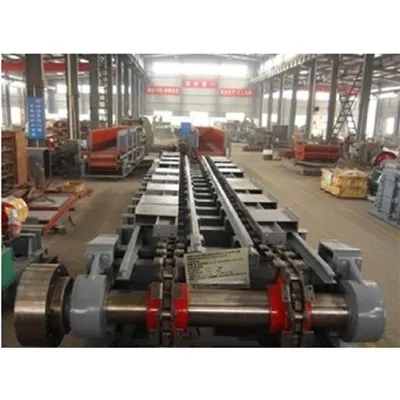
At the end of the day, scraper feeders are workhorses, but they only work right if you treat them right. Too tight isn’t “safe”—it’s a ticking time bomb that’ll cost you more in repairs, downtime, and energy than the 10 minutes you’d spend adjusting it correctly. If you’re tired of avoidable breakdowns, or you’re not sure what tension spec is right for your feeder, reach out to our team. We’ve got 8 years of experience working with all types of scraper feeders, and we can help you get your chain tension dialed in to run at peak efficiency, no unnecessary stress, no expensive surprises.
Conveyor Sprocket References: ANSI/ASME B106.1M-1985, Design of Transmission Chains; Mining Equipment Maintenance Journal, Volume 12, 2022; Bulk Solids Handling Association Technical Report 47, 2021.
Zhejiang Hangte Chain Transmission Co., Ltd.
We are one of the most experienced scraper feeder chain manufacturers and suppliers in China since 1999. Please rest assured to buy high quality scraper feeder chain made in China here from our factory. If you have any enquiry about cooperation, please feel free to email us.
Address: No.195 Qinglin East Street, Qingshan Lake Subdistrict, Lin’an District, Hangzhou City, Zhejiang Province
E-mail: hangtechain@gmail.com
WebSite: https://www.chinahtchain.com/
